

Best AI Content Detection Tools 2026
Find the best AI content detection and authenticity tools. These platforms analyze text, images, and audio to identify AI-generated content, detect deepfakes, verify originality, and flag plagiarism. Whether you are an educator, publisher, journalist, or enterprise compliance team, these tools help you maintain trust and quality standards in an environment where AI-generated content is increasingly indistinguishable from human-created work.

.svg)

AI-powered cheating detection that catches what others miss

AI-powered scam detection for calls, texts, and links in seconds
Detect AI-generated content from ChatGPT, Claude & Gemini instantly
Detect AI-generated images instantly with 100% privacy

AI-powered fraud detection and document validation for risk-critical workflows

AI job scam detector that finds real jobs and creates perfect applications
Transform AI content into authentically human writing with your personal voice

Transform AI text into undetectable human writing in seconds

Turn AI text into natural human writing - pass any detector instantly

Humanize AI text in seconds with 12+ languages and built-in AI detector

Transform AI text into natural, undetectable human writing instantly

Transform AI text into human-sounding content that bypasses all detectors
Transform AI text into undetectable human writing instantly

Free AI humanizer that makes AI text undetectable instantly

#1 Ranked AI Humanizer - Bypass All Detectors with 99.7% Success

Bypass AI detectors and humanize AI content with 99.8% success rate
Convert AI text into undetectable human writing instantly
Transform AI text into human-like writing - pass all AI detectors instantly

Most accurate AI detector backed by peer-reviewed studies

Free plagiarism checker. No ads. Real-time web comparison.
Free AI detection for essays and academic drafts - instant scoring with no signup.

Detect robotic writing patterns and humanize your content in real-time.

Detect plagiarism in seconds with 98% accuracy across 8+ languages

The most trusted AI detector with 99.98% accuracy
AI detector that preserves what's human

Sentence-level plagiarism detection across billions of sources with built-in AI detection.
Detect AI text with 95% accuracy, humanize AI content, and stay plagiarism-safe.

Detect AI-generated text with real-time analysis of ChatGPT, Gemini, and Claude content

Detect AI-generated essays and research papers with explainable sentence-level evidence.
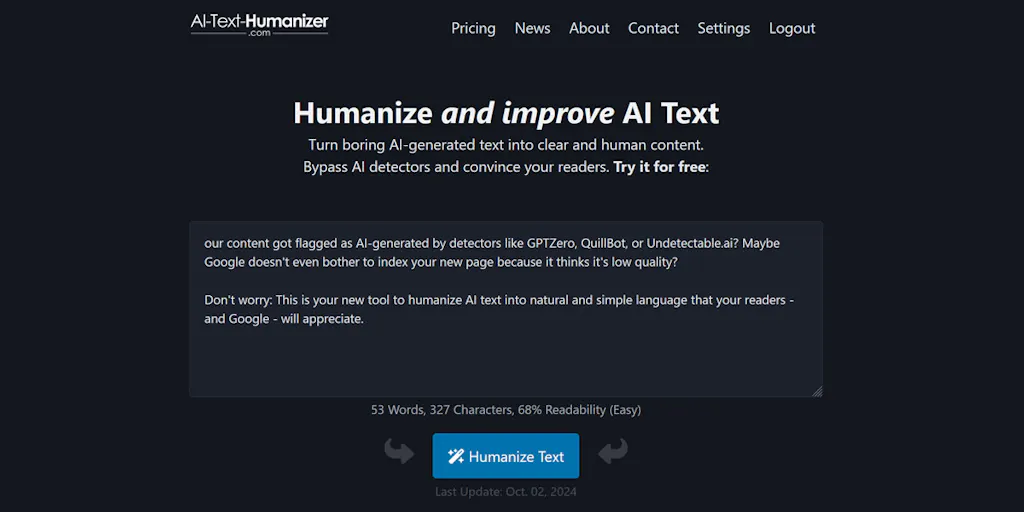
Turn AI text into undetectable human writing in one click

Detect AI-written content with 99% accuracy in seconds

Beat AI detectors and keep your writing voice intact.
As generated text became fluent, a second market appeared to answer a simple question: did a person write this? Schools, publishers, and hiring teams all want to know, and a row of tools now claims to tell them. The honest summary is that these tools give a probability, not a verdict, and treating a probability as proof is where most of the trouble starts.
Detecting, humanizing, and checking originality
Three related jobs sit in this category, and they pull against each other. Content detectors estimate how likely a passage was machine-written. Humanizers rewrite generated text to slip past those detectors. Plagiarism checkers answer a different and older question, whether the text was copied from an existing source rather than generated. Knowing which question you are actually asking decides which tool you need.
Why the accuracy never settles
Detection is a moving target by design. Every improvement in generation makes detection harder, and humanizers exist specifically to defeat detectors, so the numbers you see are a snapshot, not a fixed capability. False positives are the real danger. A detector that wrongly flags a student's own writing can do serious harm, which is why no reputable guidance treats a detector score as sole evidence.
Use it as a signal, not a sentence
The sensible posture is to treat a detection result as one input among several. Combine it with revision history, a conversation, or a writing sample before drawing a conclusion about a person. Watermarking approaches embedded at generation time are more robust than after-the-fact detection, but they only work when the generating platform adopts them. For the writing side of this equation, see the AI writing category.