NextStair
Ad
ElevenLabs: AI Voice Generator | Sign Up Now FREE
Try Now

Best AI Summarizers 2026

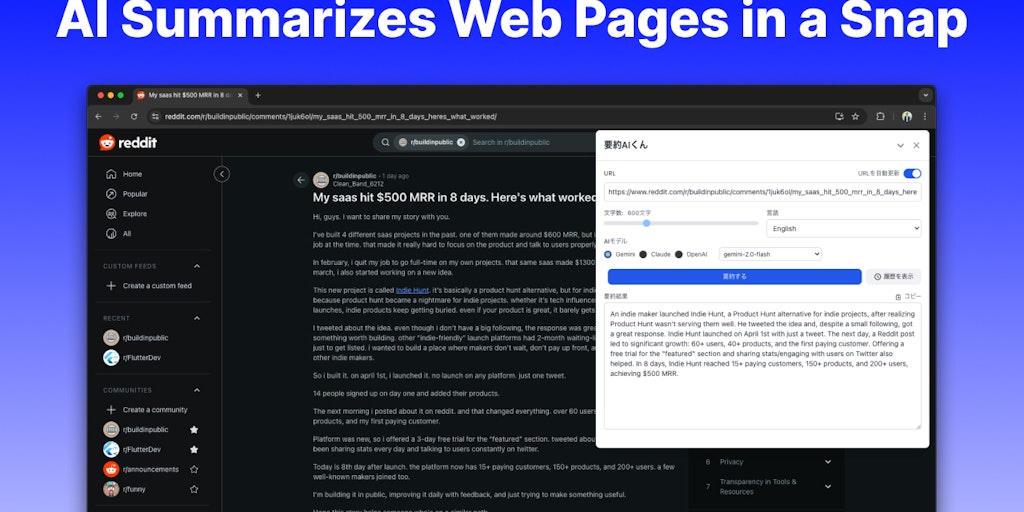
Find AI tools that condense long documents, articles, PDFs, videos, and web pages into concise summaries. These tools extract key points, action items, and main arguments - saving hours of reading and research time. Compare tools by supported input formats, summary length control, accuracy on technical content, and whether they support real-time web content or uploads only.

4 tools

There is more to read than anyone has time for, and summarizers exist to close that gap. Feed one a long report, article, or transcript and it returns the core in a fraction of the length, turning an hour of reading into a few minutes. Used well, it is less about skipping the material and more about deciding what deserves the full read.

Triage, then dive

The smartest use is as a filter. A summary tells you whether a document is worth your full attention and gives you the shape of it before you start, so you read the important parts closely and skim the rest. That is a genuine multiplier for anyone who processes a lot of information.

Related shortcuts

Summarizing sits alongside a few neighboring jobs. Paraphrasers reword rather than condense, translators handle cross-language material, and for documents specifically, the PDF summarizer tools are built for long files. Students and researchers leaning on summaries will also find the study tools category useful.

Frequently Asked Questions

How accurate are AI document summaries?â–¾
Modern AI summarizers are highly accurate for factual extraction from well-structured text. They can miss nuance, irony, and context-dependent meaning. For critical documents, always verify key claims against the original source - AI summaries are best used to guide reading priority, not replace it entirely.
Can AI summarize YouTube videos?â–¾
Yes. Tools like Summarize.tech, Glasp, and browser extensions can summarize YouTube videos using the transcript. Accuracy depends on transcript quality - auto-generated transcripts for accented speech or technical vocabulary may produce less accurate summaries than manually captioned videos.
What is the best AI tool for summarizing research papers?â–¾
Elicit, Semantic Scholar, and Explainpaper are purpose-built for academic papers - they extract methodology, findings, and limitations rather than just producing a general summary. ChatGPT and Claude also handle research papers well if you paste the full text or use their document upload features.
How accurate are AI summaries?â–¾
For clear, well-structured text they are generally reliable at capturing the main points, but they can miss nuance, drop important caveats, or occasionally state something the source does not. The risk grows with complex or ambiguous material. Use a summary to grasp the shape of a document and decide what to read closely, and verify any specific claim or figure against the original before relying on it for a decision.
Can AI summarize long documents and videos?â–¾
Yes. Many summarizers handle long PDFs, articles, and transcripts, and video tools can summarize a recording by working from its transcript. The main limit is the tool's context window, which caps how much it can process at once, though tools built for long files handle book-length material by working in sections. For dense or critical documents, a summary is a starting point rather than a full substitute for reading.
What is the difference between a summarizer and a paraphraser?â–¾
A summarizer condenses, cutting a long piece down to its essential points and making it much shorter. A paraphraser rewords, keeping roughly the same length and meaning while changing the phrasing. Use a summarizer when you want the gist of something long, and a paraphraser when you need to restate a passage differently, for clarity, tone, or to avoid copying the original wording too closely.