

Best AI Developer Frameworks Tools 2026
Find the best frameworks, libraries, and SDKs for building AI-powered applications. From LangChain, LlamaIndex, and AutoGen to vector database clients, embedding libraries, evaluation frameworks, and model deployment tools - this category covers the developer tools that power the AI application layer. Compare frameworks by use case, language support, community size, and production readiness.
.svg)


Ship AI agents to production with confidence

Spawn agents from issues, ship more code in parallel.

Monitor, control, and trust every AI agent conversation at scale
Open-source agentic runtime for AI agents that collaborate autonomously

TypeScript SDK for agents with self-improving temporal memory

Open-source meta-agent framework for orchestrating complex multi-agent tasks reliably

Persistent memory for AI agents that actually remembers.

Thousands of web components and templates - build beautiful faster

Build and deploy AI agents in minutes - no coding required.

AI agent that lives in your repo and learns through git commits

Chatbots with faces that express what they understand
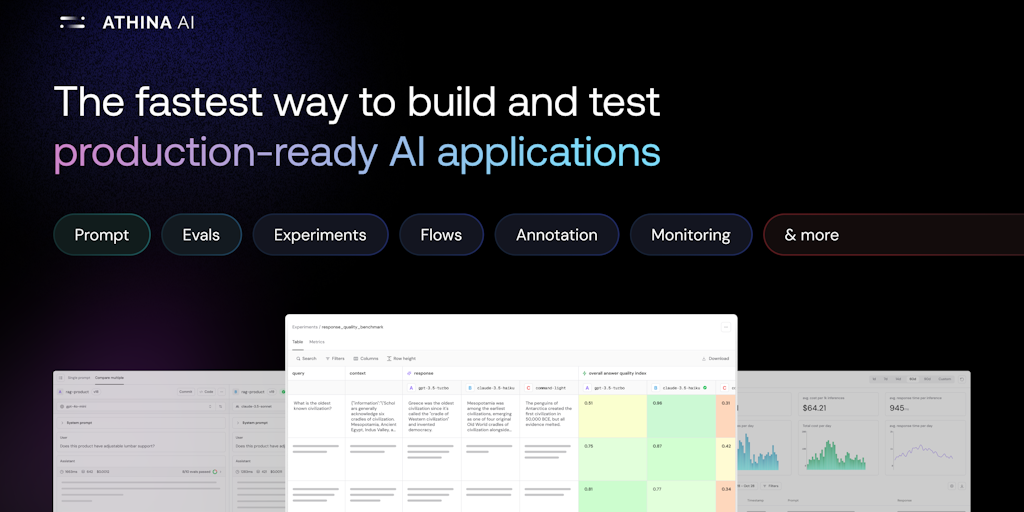
Ship AI to prod 10x faster with collaborative development & monitoring

Intelligent model routing that automatically improves from your production traffic
Trace, manage, and evaluate LLM apps from prototype to production at scale

Enterprise AI data platform with sovereign storage and 100+ language support

Deploy full-stack apps in 15 seconds - no engineer required.

Build durable AI agents in TypeScript that survive anything
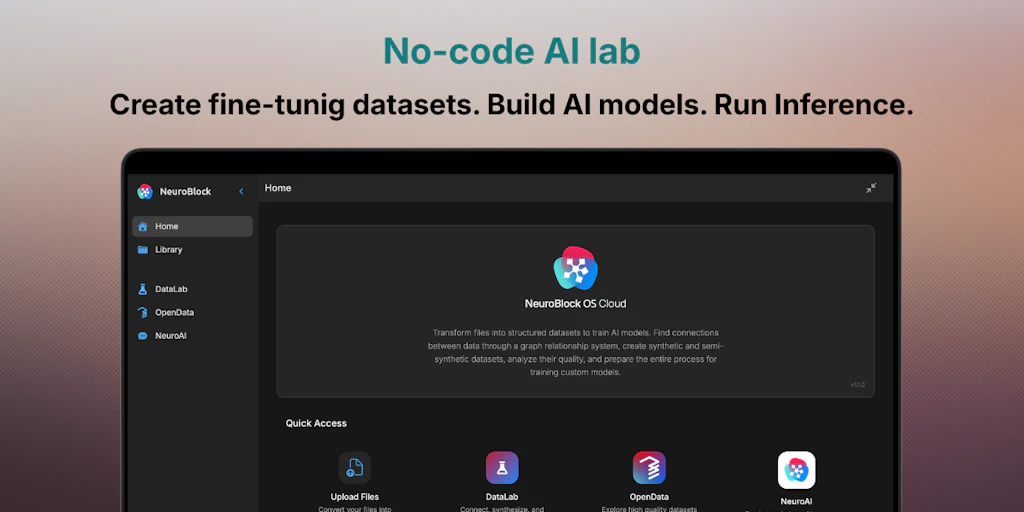
Build your own expert AI models - own the innovation, cut the costs

Enterprise control plane for observing and securing production AI agents

Train ML models on your iPad with live predictions and visual controls

One API for all AI models - serverless, fast, and OpenAI-compatible
30+ free Minecraft tools for building, servers, and calculations

Build AI prompt chains at typing speed, no coding required

Build and deploy production-ready AI agents without code - on your infrastructure.

AI that knows your business and automates it in minutes.

Unified Python interface for multi-provider LLM integration

Build, ship, and govern AI agents on one sovereign platform

Open-source LLMOps platform for prompt management, evaluation, and observability
Orchestrate 40+ AI agents from idea to shipped code in one CLI

One database for vectors, graphs, documents, and time-series - built for AI agents

Deploy a private ChatGPT alternative powered by open-source LLMs in your VPC

Graph-native RAG engine unifying vectors, graphs, and LLM reasoning
Vector database for AI with instant searchability and automatic indexing at any scale

Generate embeddings natively in Qdrant Cloud - no external pipelines needed.
Build AI workflow automations without code - visual canvas meets multi-agent orchestration

Production-ready generative AI infrastructure built for scale
A raw language model is powerful and helpless at the same time. It can reason about text, but on its own it cannot remember a past conversation, look something up, or take an action in the world. AI frameworks are the connective tissue that fixes that, giving developers the memory, retrieval, and tool-use patterns needed to turn a model into an actual application rather than a chat box.
Orchestrating models and agents
The core building blocks handle control flow. LLM orchestration tools like LangChain and LlamaIndex chain prompts, manage context, and connect a model to data, while agent frameworks such as CrewAI and LangGraph coordinate models that plan, use tools, and work in steps toward a goal.
Memory and retrieval
Most useful AI apps need to ground answers in specific data, and that runs on vector databases. They store text as embeddings and find the most relevant pieces to feed a model, which is the heart of retrieval-augmented generation. When it is time to ship, LLM deployment tools handle serving, scaling, and cost.
Framework or plain SDK
Frameworks accelerate the common patterns, but they add abstraction, and a simple app is sometimes clearer built directly against a model's SDK. The honest guidance is to reach for a framework when you need agents, memory, or retrieval, and skip it when a few API calls would do. These frameworks are how an AI agent is actually built, and they increasingly speak MCP to reach external tools.